Why Backup Generators Stall on Motor Startup: Modeling Locked Rotor Amps (LRA) and Non-Coincident Inrush Dynamics in TypeScript
A computational breakdown of inductive motor inrush physics, generator sub-transient reactance, and non-coincident peak load modeling in clean energy backup systems.
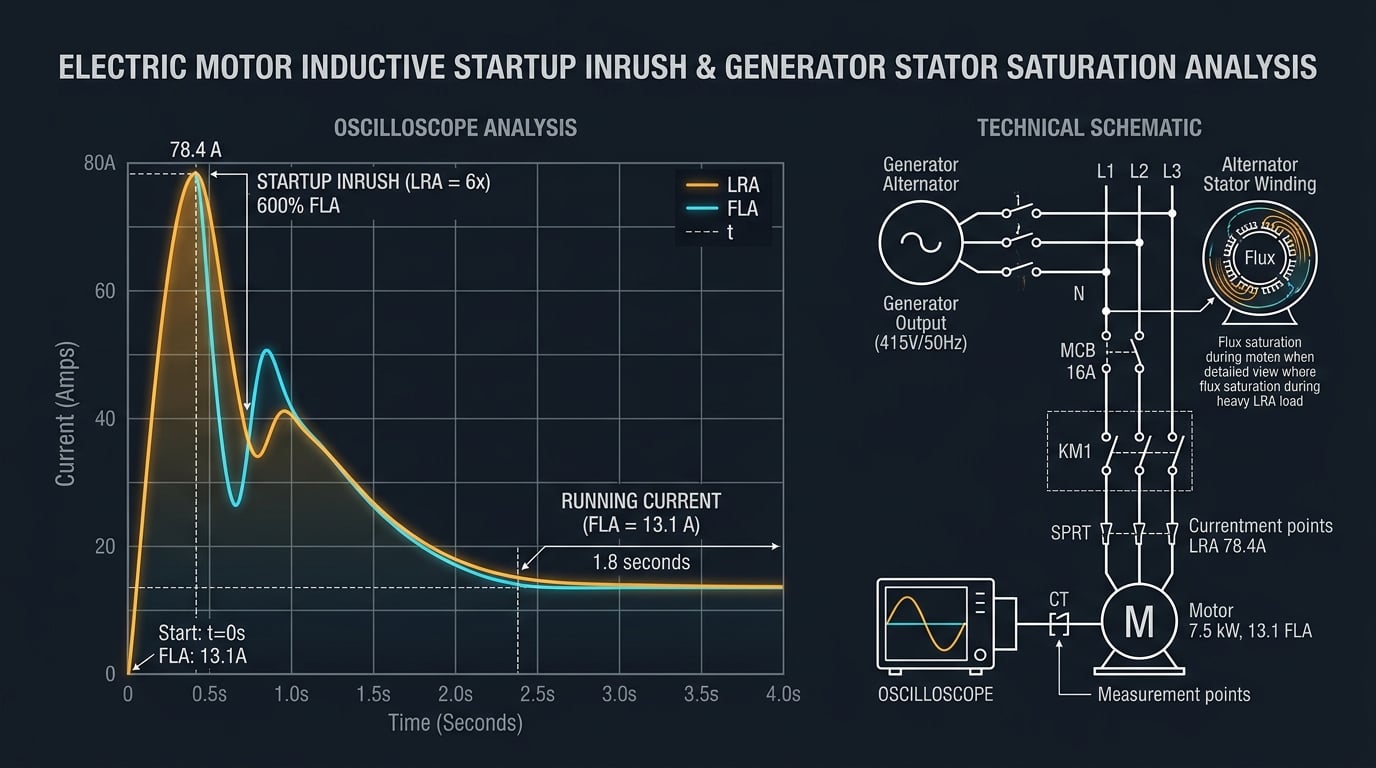
During grid outages, residential backup systems often encounter an unexpected failure: a 10,000-watt generator stalls or trips its primary breaker the instant a 3,500-watt central air conditioner attempts to cycle on.
To homeowners and even many electrical contractors, this failure appears paradoxical. A 10 kW generator provides 10,000 continuous watts, and the air conditioner nameplate specifies a running draw of only 3,500 watts. On paper, the system retains a 6,500-watt safety margin.
In physical reality, the system collapses because alternating current (AC) induction motors do not start at their rated running power. During the initial 50 to 150 milliseconds of motor startup, the rotor is physically stationary. With zero counter-electromotive force (back-EMF) developed in the armature, the motor behaves as a direct transformer short-circuit.
This transient demand is governed by Locked Rotor Amps (LRA), where current draw spikes to 5 to 7 times the continuous Full Load Amps (FLA). Unless an emergency generator incorporates sufficient sub-transient reactance headroom or soft-starting electronics, the instantaneous voltage drop collapses the generator field excitation.
The Physics of Inductive Inrush
When an induction motor is energized from rest, the current waveform consists of two components: a symmetrical alternating current component and an asymmetrical direct current offset dictated by the point on the voltage wave where contact closure occurs.
Under NEMA Standard MG-1 (Motors and Generators) and IEEE Std 399 (Brown Book), the starting apparent power per horsepower is categorized by NEMA Code Letters (ranging from Code A to Code V):
$$S_{\text{start}} = \text{HP} \times \text{kVA/HP}_{\text{code}}$$
For typical residential hermetic compressor motors (predominantly NEMA Code G to Code J), starting kVA ranges from $5.6$ to \(7.99,\text{kVA per horsepower}\).
The relationship between starting inrush current and running current is expressed as:
$$I_{\text{start}} = I_{\text{FLA}} \times \left( \frac{\text{LRA}}{\text{FLA}} \right) \approx 5.5 \times I_{\text{FLA}} \dots 7.0 \times I_{\text{FLA}}$$
For a typical 3.5-ton central air conditioner operating on a 240V split-phase circuit:
- Running Full Load Amps (\(I_{\text{FLA}}\)): \(14.6,\text{A}\) (\(3,500,\text{W}\) at $0.92$ power factor)
- Locked Rotor Amps (\(I_{\text{LRA}}\)): \(78.0,\text{A}\)
- Instantaneous Starting Power: \(78.0,\text{A} \times 240,\text{V} = 18,720,\text{VA} \approx 18.7,\text{kW}\)
When this 18.7 kW starting transient hits a standard 10 kW portable generator, the mechanical engine lacks the kinetic rotational inertia to supply the transient torque. Simultaneously, the alternator stator experiences severe magnetic flux saturation, causing output voltage to sag below 85V. The compressor contactor chatters, the motor stalls, and the generator's thermal-magnetic circuit breaker trips.
Non-Coincident Peak Sizing Methodology
A naive sizing model sums the starting wattages of all appliances in a household. If a home operates a refrigerator (1,200W surge), a well pump (4,000W surge), a sump pump (2,100W surge), and an air conditioner (18,700W surge), simple summation suggests requiring a 26 kW generator.
However, in deterministic electrical modeling, motor startups are non-coincident events. The statistical probability of four independent inductive motors energizing in the exact same 100-millisecond window is near zero.
Under standard engineering sizing protocols:
- Calculate the total continuous running watts of all connected base loads.
- Identify the single largest inductive motor in the entire schedule.
- Compute the maximum inductive surge delta:
$$\Delta P_{\text{surge,max}} = \max_{i \in \text{Appliances}} (P_{\text{starting},i} - P_{\text{running},i})$$
- Dimension the peak generator capacity to support continuous base load plus the single worst-case surge delta:
$$P_{\text{peak}} = \sum P_{\text{running}} + \Delta P_{\text{surge,max}}$$
This model is codified in our open deterministic generator sizing engine, preventing unnecessary equipment over-sizing while ensuring reliable compressor starts.
Pure TypeScript Implementation
Below is the deterministic sizing algorithm implemented in pure TypeScript without external database dependencies:
export interface GeneratorAppliance {
  id: string;
  label: string;
  runningWatts: number;
  startingWatts: number;
  quantity: number;
}

export interface GeneratorSizingResult {
  totalRunningWatts: number;
  maxInductiveSurgeDelta: number;
  targetContinuousWatts: number;
  targetPeakSurgeWatts: number;
  recommendedHardwareClass: string;
  recommendedNemaOutlet: string;
  recommendedCordGauge: string;
}

export function calculateGeneratorSize(
  appliances: GeneratorAppliance[],
  safetyMarginFraction: number = 0.20
): GeneratorSizingResult {
  if (!appliances || appliances.length === 0) {
    throw new Error("At least one electrical load must be provided.");
  }

  let totalRunningWatts = 0;
  let maxInductiveSurgeDelta = 0;

  for (const item of appliances) {
    if (item.runningWatts <= 0) {
      throw new Error(`Running power for ${item.label} must be positive.`);
    }

    const qty = Math.max(1, item.quantity || 1);
    totalRunningWatts += item.runningWatts * qty;

    const singleItemSurge = Math.max(item.runningWatts, item.startingWatts || item.runningWatts);
    const surgeDelta = singleItemSurge - item.runningWatts;

    if (surgeDelta > maxInductiveSurgeDelta) {
      maxInductiveSurgeDelta = surgeDelta;
    }
  }

  const totalStartingSurgeWatts = totalRunningWatts + maxInductiveSurgeDelta;
  const targetContinuousWatts = Math.round(totalRunningWatts * (1 + safetyMarginFraction));
  const targetPeakSurgeWatts = Math.round(totalStartingSurgeWatts * (1 + safetyMarginFraction));

  // Determine NEMA configuration and hardware class
  let recommendedHardwareClass = "2,000W - 2,500W Inverter Generator";
  let recommendedNemaOutlet = "NEMA 5-20R (120V 20A)";
  let recommendedCordGauge = "12 AWG Heavy Extension Cord";

  if (targetContinuousWatts > 7500) {
    recommendedHardwareClass = "10,000W - 12,500W Heavy Portable / Standby";
    recommendedNemaOutlet = "NEMA 14-50R (120V/240V 50A 4-Prong)";
    recommendedCordGauge = "6 AWG 4-Conductor Power Cord";
  } else if (targetContinuousWatts > 3800) {
    recommendedHardwareClass = "7,500W - 9,500W Dual-Fuel Generator";
    recommendedNemaOutlet = "NEMA L14-30R (120V/240V 30A Twist-Lock)";
    recommendedCordGauge = "10 AWG 4-Conductor Generator Cord";
  } else if (targetContinuousWatts > 2200) {
    recommendedHardwareClass = "3,500W - 4,500W Portable Generator";
    recommendedNemaOutlet = "NEMA TT-30R / L5-30R (120V 30A)";
    recommendedCordGauge = "10 AWG Heavy Duty 3-Prong Cord";
  }

  return {
    totalRunningWatts,
    maxInductiveSurgeDelta,
    targetContinuousWatts,
    targetPeakSurgeWatts,
    recommendedHardwareClass,
    recommendedNemaOutlet,
    recommendedCordGauge,
  };
}
Mitigating LRA: The Soft Starter Solution
For homeowners seeking to run central air conditioning on a modest 7,000W to 9,000W generator, replacing the generator is rarely the most cost-effective path.
Installing an electronic soft starter (such as a Micro-Air EasyStart or Hyper Engineering SureStart) directly at the compressor contactor alters the startup dynamics:
- Phase-Fired Voltage Ramping: Solid-state thyristors ramp input voltage over 100 to 300 milliseconds.
- Current Limitation: Inrush current is restricted to approximately 30% to 35% of factory LRA.
- Mechanical Stress Reduction: Torque is applied smoothly, dampening bearing shock and prolonging compressor lifespan.
For a 78A LRA compressor, a soft starter restricts peak inrush to approximately 24A to 28A (\(5.7,\text{kW}\) to \(6.7,\text{kW}\) peak surge). This enables a standard 3.5-ton heat pump to start cleanly on a portable 8,000W dual-fuel generator alongside basic refrigeration and lighting.
To evaluate full building cooling and heating electrical demands during design, review our detailed Emergency Generator Sizing and Inrush Load Guide or model seasonal operating expenses using the Central Air Conditioner Cost Calculator.
Summary Rules for System Designers
- Verify the LRA Nameplate: Always inspect the compressor data plate for Locked Rotor Amps rather than relying on nominal tonnage or running watts.
- Apply Non-Coincident Logic: Size continuous alternator capacity for aggregate loads, but size peak surge capacity strictly for continuous base load plus the single largest delta surge.
- Observe Voltage Drop on Generator Leads: High inrush currents compound resistive losses in undersized cords. A 70A starting surge across a 50-foot 10 AWG extension cord induces a severe line voltage drop that stalls the motor before reaching operational speed.
About the author
- Lead Engineer at PowerLab (https://powelab.org). Researching and building deterministic computational modeling engines for distributed solar PV, battery energy storage systems (BESS), and power electronics under NEC and IEEE standards.
Comments
Join the discussionNo comments yet. Be the first to comment.
Clean Energy Computational Modeling
Technical teardowns, mathematical derivations, and open-source TypeScript calculation engines for distributed solar PV, battery energy storage (BESS), and power electronics under NEC 2023 and IEEE standards.